
CS2 Trade-Up Contracts
Compare contract estimates: check the wear, enter actual floats, then verify available listings.
How to choose and build a contractClick skin cards below → fill the slots → inspect possible outcomes and cost.
Prices are asking prices for the stated wear, not guaranteed sale proceeds. The full quantity and selected floats may cost more. The selected selling fee is an assumption; deposit and withdrawal fees are extra.
This page is about Trade Up Contracts — a mechanic inside the game CS2: you run them in your own Steam inventory. This site does not perform trades, does not take your skins and is not affiliated with Valve — everything below is for information only.
Build a contract
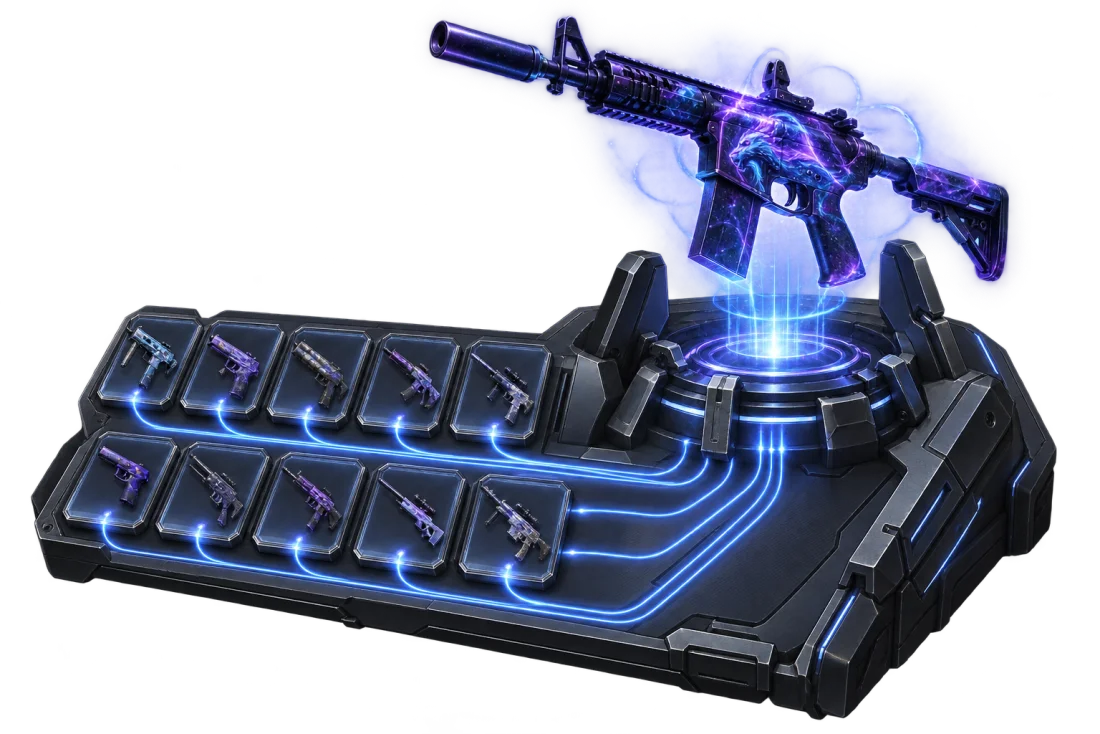
A contract takes items of a single rarity: ten on the regular transitions and five on Covert → knife or gloves. In return you get 1 random item of the next rarity from the collections your inputs belong to. Each collection’s chance is proportional to how many of your inputs come from it.Drag fillers from the grids below into the slots — or just click a card and it takes the first free slot. Enter or Escape on a slot removes the item.
Add the first item — it sets the rarity for the whole contract.
Reference prices by wear, after the selected selling fee. These are not predicted outcomes. Enter every input float to calculate your output wear, price and profit.
Prices are asking prices for the stated wear, not guaranteed sale proceeds. The full quantity and selected floats may cost more. The selected selling fee is an assumption; deposit and withdrawal fees are extra.
10 → 1
A contract takes items of a single rarity: ten on the regular transitions and five on Covert → knife or gloves. In return you get 1 random item of the next rarity from the collections your inputs belong to. Each collection’s chance is proportional to how many of your inputs come from it.
Example: 7 inputs from collection A (4 outputs) and 3 from collection B (2 outputs): chance of A = 7/10 = 70%, each of its skins ≈ 70% / 4 = 17.5%; chance of B = 30%, each skin ≈ 15%.
Output float
Each input’s float is normalized within its own range: (float − min) / (max − min). The average of these values is projected into the output’s range.
n = average over 10 inputs ( (float − min) / (max − min) ) output float = out_min + n × (out_max − out_min)Example: 10 inputs averaging n = 0.10 with an output range of 0.00–0.50 → 0 + 0.10 × 0.5 = 0.05 — Factory New.
StatTrak™ separately
Inputs must be either all StatTrak™ or all non-StatTrak — no mixing. Souvenir items are accepted alongside normal ones: all Souvenir attributes are removed and the result is a normal item (Souvenirs cannot go into a StatTrak™ contract). Five Covert items from one collection are exchanged for a knife or gloves from that collection.
Example: 10 StatTrak™ inputs → a StatTrak output; 10 regular → a regular one. 9 regular + 1 StatTrak simply cannot be placed into a contract. Five StatTrak™ Covert items give a StatTrak™ knife; StatTrak™ gloves do not exist.
Economics
A contract is profitable when 10 × the input price is below the expected value of the output. Odds are split by how many inputs come from each collection and shared evenly among that collection’s outputs, so a cheap filler from a collection with a few expensive outputs is what you are looking for.
Example: 10 fillers at $0.30 = $3.00 in. If the average price of possible outputs is $4.20, expected value is +$1.20; if it is $2.00, the contract loses money.
Trade Up Contracts are a mechanic inside the game CS2 (Valve). This site does not perform trades, does not take items and is not affiliated with Valve Corporation. Prices come from external marketplaces and may differ from current listings. This material is for information only and is not financial advice.
A trade-up contract is an in-game CS2 mechanic by Valve. This site does not trade, does not accept items and is not affiliated with Valve Corporation. Prices come from external markets, refresh hourly and may differ from the live ones; buying ten lots at the shown price is not always possible. On top of the selling fee there are deposit and withdrawal fees, and an item bought on a third-party market arrives by trade and cannot be resold on Steam for seven days. Expected value is an average over many repetitions, not a promise about one attempt: for most contracts the chance of getting back less than you spent is above 50%. Informational material, not financial advice.